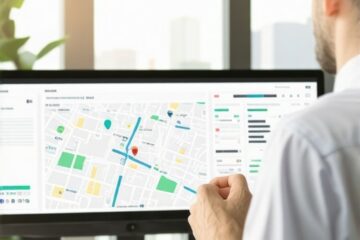
4 Small Tweaks That Turn Your Map Views Into Real Customer Clicks
In the high-stakes world of local search, there is a metric that often acts as a siren song for business owners: “Views.” We see those monthly insights emails from Google showing thousands of impressions, and we feel a sense of accomplishment. But as an SEO consultant who has spent years in the trenches, I’m here to tell you that views are a vanity metric. If those thousands of views aren’t translating into phone calls, direction requests, and website visits, your profile is essentially a digital billboard in the middle of a desert.
Welcome to the “Visibility Trap.” According to SOCi’s 2024 Consumer Behavior Index, 80% of Americans search for local businesses at least once a week. Furthermore, 46% of all Google searches have local intent. With over 200 million businesses currently listed on Google Maps, the competition for attention is no longer just about showing up; it’s about winning the click. In 2026, the landscape has shifted. Following the “September 2025 Google Core Update,” the way AI Overviews (AIO) interact with local results has fundamentally changed the game. Visibility is no longer enough; conversion is the new currency.
If you’ve ever wondered Why Your Business Profile Fails to Generate Real Phone Calls, you are likely missing the bridge between being seen and being chosen. This guide will walk you through four specific, data-backed tweaks that move the needle from passive impressions to active customer engagement.
Tweak #1: Semantic Category Layering for Neural Matching
Most business owners treat their primary category as a “set it and forget it” task. They pick “Plumber” or “Italian Restaurant” and stop there. However, to truly master google business profile seo, you must understand the evolution of “Neural Matching.” This is Google’s sophisticated method of connecting a searcher’s nuanced intent to a business’s specific attributes, and it relies heavily on your category structure.
The tweak here is “Semantic Category Layering.” While your primary category dictates your main “bucket,” your secondary categories act as the connective tissue for “near me” searches. In the post-2025 search environment, Google’s algorithm doesn’t just look for a keyword match; it looks for semantic relevance. If someone searches for “emergency pipe repair near me,” and you only have “Plumber” as your category, you might rank, but you won’t be as relevant as a competitor who has layered “Repair Service” and “Emergency Service” as secondary categories.
To rank google business profile effectively, you need to audit your secondary categories quarterly. Google frequently updates the available list of categories, and missing out on a new, more specific one can cost you clicks. For example, a local gym might find better conversion by adding “Personal Trainer” or “Yoga Studio” rather than just sticking to “Physical Fitness Center.”
When you align your secondary categories with high-intent searches, you are providing the “Neural Matching” engine with the data it needs to recommend you. This isn’t about keyword stuffing; it’s about defining the scope of your expertise. For a deeper dive into this, check out my guide on The 3 Attributes Google Actually Uses to Rank Your Shop Locally. By layering these categories, you ensure that when a user has a specific problem, Google sees you as the specific solution.
Tweak #2: The “Service Menu” Keyword Injection for AI Overviews
One of the most underutilized features in the Google Business Profile dashboard is the “Services” editor. Many owners leave this blank or allow Google to auto-populate it with generic terms. This is a massive mistake in the era of google business profile optimization. Since the September 2025 Core Update, Google’s AI Overviews (AIO) have become the primary way users digest local information. AIO doesn’t just pull from your website; it pulls heavily from the structured data within your profile.
The “Service Menu” keyword injection involves writing detailed, 300-character descriptions for every single service you offer. Instead of just listing “Roof Repair,” your description should read: “Comprehensive residential roof repair for leak detection, shingle replacement, and storm damage restoration in [City Name]. We use GAF-certified materials to ensure long-lasting protection.”
Why does this work? Because Google uses these descriptions to verify if you can solve a customer’s specific problem. When a user asks an AI-powered search “Who is the best contractor for hail damage repair in Austin?”, the AIO scans service descriptions to find the most relevant match. If your profile contains those specific keywords within the service descriptions, your chances of being the “featured” local recommendation skyrocket.
Using local seo tools can help you identify which specific service keywords are trending in your area. This isn’t just about ranking; it’s about providing the “proof” the AI needs to vouch for your business. This strategy is also a critical component of 3 Local Schema Markup Fixes for 2026 Search Accuracy, as it aligns your on-profile data with the structured data on your website.
Tweak #3: Visual Social Proof & “Recency” Over Quality
We’ve been told for years that high-quality, professional photography is the key to a great profile. While professional shots are great for branding, they often lack the “authenticity” that modern consumers crave. In 2026, click-through rates (CTR) are increasingly driven by “Customer-Generated Content” (CGC). A grainy, smartphone photo of a finished kitchen remodel uploaded by a happy customer often carries more weight than a staged, high-resolution photo from the business owner.
This tweak is about maximizing your google maps visibility through “Recency.” Google’s algorithm favors profiles that show active, ongoing engagement. A profile with 50 photos from three years ago looks stagnant. A profile with 5 new photos uploaded every week – especially by customers – looks like a thriving business. Profiles with high volumes of user-uploaded photos consistently see higher CTRs because they provide “Visual Social Proof.”
To implement this, you must actively prompt your customers to upload photos with their reviews. You can even gamify this process or include a call-to-action in your follow-up emails. When a customer uploads a photo, it attaches a level of trust that a business-owner photo simply cannot replicate. It shows the “real” experience.
If you want to rank higher on google maps, you need to understand that the algorithm views “Recency” as a signal of reliability. If you haven’t had a new photo uploaded in 30 days, your “relevance” score begins to dip. This is a common pitfall I discuss in Why Local Contractors Get Ghosted by Google Maps Even with Great Photos. To combat this, make photo collection a standard part of your fulfillment process.
Tweak #4: Review Velocity & Semantic Response
Most businesses know they need reviews, but they focus solely on the “Star Rating.” While a 4.8 is better than a 4.2, the algorithm has become much more sophisticated. In 2026, Google prioritizes two things: “Review Velocity” and “Semantic Response.”
Review Velocity is the speed and consistency at which you receive new reviews. If you get 20 reviews in one week and then nothing for three months, it looks suspicious to the algorithm. To google maps optimization your profile, you need a steady stream of feedback. Consistency signals to Google that you are a consistently active and reliable business.
Semantic Response is the “tweak” that most people miss. When you respond to a review, don’t just say, “Thanks for the 5 stars!” Instead, use natural, location-based, and service-based language. A semantic response looks like this: “Thank you, Sarah! We were happy to help with your AC installation in [Neighborhood Name]. It was a pleasure ensuring your home stays cool during this heatwave.”
By including the service (“AC installation”) and the location (“[Neighborhood Name]”), you are feeding the “Neural Matching” engine more data. This helps increase google maps exposure because you are reinforcing your relevance for those specific terms without “keyword stuffing” in a way that looks spammy to humans. Google reads your responses to understand the context of your business interactions.
Furthermore, using a gmb ranking service can help automate the monitoring of these reviews, but the response itself should always feel human. For more on how this impacts your long-term standing, read How Consistent Review Velocity Signals Authority to Google Maps. High velocity combined with semantic responses creates a feedback loop that tells Google you are the most authoritative option in your area.
Conclusion: The 2026 Outlook
The days of “set it and forget it” for Google Business Profiles are officially over. As we navigate the complexities of AI Overviews and Neural Matching, the gap between businesses that simply “exist” on the map and those that “convert” will only widen. By implementing semantic category layering, injecting keywords into your service menu, prioritizing customer-generated visual proof, and maintaining a healthy review velocity with semantic responses, you are doing more than just “ranking.” You are building a high-conversion engine.
Stop focusing on how many people saw your pin on the map and start focusing on how many of those people felt compelled to click. The data shows that the most successful businesses in 2026 are those that provide the most context to both the AI and the human user. Use these four tweaks to ensure your profile doesn’t just take up space, but actually drives revenue.
If you’re ready to take the next step, I recommend performing a full audit of your current presence. You can start with The 10-Point Checklist for a Faster Google Maps SEO Audit to see where your biggest opportunities for improvement lie. For those looking for more advanced assistance, utilizing local seo software or google maps seo tools can provide the competitive edge needed to dominate your local market.
The map is your storefront. Make sure the door is wide open and the invitation is clear.
– Kevin Pauls
Local SEO Consultant | Google Business Profile Product Expert