Why Your Map Position Changes Depending on Which Street You Stand On
It is a Tuesday morning, and you are standing inside your storefront. You pull out your phone, open Google, and search for your primary service. There you are: the coveted #1 spot in the Map Pack. You feel a surge of pride. This is google business profile seo at its finest, you think.
An hour later, you walk three blocks down the street to grab a coffee. You check again. Suddenly, your business is nowhere to be found. You aren’t just #2 or #3; you’ve vanished from the top three results entirely, replaced by a competitor who is technically further from the city center than you are. You haven’t changed your keywords, your reviews didn’t disappear, and your website didn’t crash. So, what happened?
Welcome to the phenomenon I call “Proximity Volatility.” In the world of local search, your ranking is not a fixed trophy – it is a liquid state that shifts based on the literal inches of pavement beneath a searcher’s feet. To understand why this happens, we have to look at the three pillars of Google’s local algorithm: Relevance, Distance, and Prominence. While most business owners focus heavily on relevance (keywords) and prominence (reviews), it is Distance – the proximity factor – that acts as the ultimate “Wild Card” in 2026.
According to Google’s official documentation, local results are based primarily on these three factors. However, the way they interact is far more complex than a simple radius. If you’ve ever wondered why your visibility seems to evaporate the moment you leave your parking lot, you need to understand The Proximity Fix: Why Your Shop Disappears Two Blocks Away.
The Three Pillars: Why Distance is the “Wild Card”
To master google business profile seo, you must treat the algorithm as a balancing act. Google’s goal is to provide the most helpful result for the user’s specific intent. To do this, it weighs three distinct categories of data:
- Relevance: How well does your local business profile match what someone is searching for?
- Distance: How far is each potential search result from the location terms used in a search? (If the user doesn’t specify a location, Google calculates distance based on what’s known about their location.)
- Prominence: How well-known is the business? This is based on information that Google has about a business from across the web (links, articles, directories, and review count/score).
While Relevance and Prominence are relatively stable – your website content and your backlink profile don’t change minute-by-minute – Distance is a moving target. Google determines the “centroid” of a search using a sophisticated mix of GPS data, Wi-Fi signals, and IP addresses. Even if a user has “Location Services” turned off, Google can often triangulate their position based on the strength of nearby Wi-Fi routers and cellular towers.
This creates a hyper-local environment where the “winner” of the search changes as the user moves. For a deep dive into how these signals work, check out Understanding Ranking Issues on Maps: Expert Tips for Better Local Search. If you want to see how your own business measures up against these factors, using professional google business profile seo tools is the only way to get an unbiased view.
The Geographic Grid & The “Heatmap” Reality
One of the most common misconceptions I hear from clients is: “I rank #1 in Chicago.” My response is always the same: “Where in Chicago?” Ranking #1 at the corner of Michigan and Wacker does not mean you rank #1 in Logan Square. In fact, you might not even be in the top 20 there.
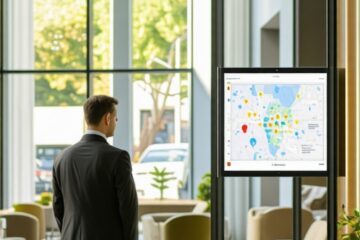
Rankings do not exist on a city-wide basis; they exist on a coordinate grid. If you were to look at a map of your city and place a dot every 500 meters, your ranking would be different at every single one of those dots. This is what we call a “Heatmap.” In high-density areas, your rank can drop from #1 to #10 within just a few hundred meters. This is especially true in competitive niches like personal injury law or emergency plumbing.
To visualize this, experts use a google maps rank tracker or other local seo ranking tools. These tools generate a grid of “pins” over a map, showing you exactly where your “Proximity Bubble” ends. You might find that you dominate a 2-mile radius to the North, but your visibility is cut off abruptly to the South by a competitor with higher Prominence. Understanding this grid is the first step to moving beyond the “one-spot” mindset and toward true local seo tools mastery.
Neural Matching and the 2026 Proximity Filter
As we move through 2026, Google’s algorithm has become significantly more “intelligent” through the use of Neural Matching. This is an AI-based system that helps Google understand the underlying intent of a search, even when the user’s query is vague. For example, if someone searches for “why is my sink making a gurgling noise,” Google knows the user likely needs a plumber and will trigger the Map Pack accordingly.
However, Neural Matching has also led to the “Proximity Filter.” Google has learned that for certain types of businesses, users are willing to travel further, while for others, they want the absolute closest option.
- Tight Radius: For “common” services like coffee shops, gas stations, or dry cleaners, Google “tightens” the proximity filter. If there is a coffee shop 100 feet away, Google is unlikely to show you one 2 miles away, regardless of how many reviews it has.
- Wide Radius: For “niche” or “high-stakes” services – think specialized surgeons, luxury car dealerships, or boutique wedding venues – Google “widens” the filter. They understand that a user is willing to drive 20 miles for the right specialist.
This is a critical distinction. If you are in a “Tight Radius” industry, your local search optimization strategy must focus on dominating the immediate blocks around you. If you are in a “Wide Radius” industry, you have more room to play with Prominence to outrank closer competitors. You can learn more about this AI layer in our guide on How Google’s Neural Matching Decides Which Local Shops Get Found. To analyze your industry’s specific radius, utilizing google maps seo tools is essential.
Why Your Competitors “Follow” You
Have you ever noticed a competitor who seems to outrank you even when the searcher is standing right in front of your office? This is the point where “Prominence” overrides “Distance.” If a competitor has a significantly stronger digital footprint – more high-quality backlinks, a higher volume of recent reviews, and better engagement – Google may decide that they are a “better” result for the user, even if they are a mile further away.
In local SEO communities on Reddit and Facebook, business owners often complain about “ranking instability.” They see their positions fluctuate daily despite making no changes. Often, this isn’t a glitch; it’s a shift in the neighborhood’s relative Prominence. If a competitor across town suddenly gets a PR mention in a local news outlet or sees a surge in 5-star reviews, their “authority radius” expands, potentially pushing you out of the Map Pack in areas you used to own.
This is why review velocity is so important. It’s not just about having 500 reviews; it’s about having 10 new reviews this month. For more on this, read How Consistent Review Velocity Signals Authority to Google Maps. To rank higher on google maps, you must constantly feed the Prominence pillar to keep your “radius” from shrinking.
Don’t let your competitors take your territory. Use rank higher on google maps strategies to ensure your prominence is high enough to bridge the distance gap.
How to “Expand” Your Ranking Radius
While you cannot physically move your building closer to every potential customer, you can move your “digital footprint.” To rank google business profile effectively across a wider area, you need to build what I call “Local Authority.” This signals to Google that you are the most relevant and prominent choice for the entire region, not just your street corner.
Here are the tactical moves to combat proximity limitations:
- Hyperlocal Content: Create blog posts and landing pages about specific neighborhoods, landmarks, and local events. This tells Google you are active and relevant in those specific geographic areas. See The Hyperlocal Content Move That Actually Brings Neighbors Through Your Front Door for a step-by-step guide.
- Local Citation Building: Ensure your Name, Address, and Phone Number (NAP) are consistent across all local directories and niche-specific sites. Consistency is the bedrock of trust for the algorithm.
- Geo-Tagged Images: Upload photos to your Google Business Profile that were taken at various job sites or locations within your service area. The metadata in these photos provides subtle geographic signals to Google.
- Aggressive Review Strategy: Focus on getting reviews from customers located in different parts of the city. When a user mentions a specific neighborhood in their review (“Best plumber in Lincoln Park!”), it creates a strong local signal.
By implementing these strategies, you can effectively “stretch” your proximity bubble. You can find more advanced techniques in our google business profile optimization resources.
Conclusion & The 2026 Outlook
The “Proximity” factor is the most volatile element of google business profile seo because it is the only factor you cannot fully control. You can’t move your storefront every time a customer searches from a new street. However, by understanding the geographic grid and focusing on the Prominence pillar, you can prevent your business from being “filtered out” by closer, yet less authoritative, competitors.
As we look toward the rest of 2026, expect Google to lean even harder into AI-driven intent. The “Proximity Filter” will only get smarter. Your goal shouldn’t be to rank #1 everywhere – that’s impossible. Your goal should be to maximize your “Ranking Surface Area” by being the most prominent and relevant choice within a healthy, expanding radius.
Is your business currently being “hidden” by the proximity filter? Don’t guess. Perform a 5-Minute Audit for Businesses Not Ranking in Maps [2026] to see exactly where your grid stands today and where you need to grow.